Contact Me
Back to Work
B2C Research VR / XR

Motional VR – Innovating VR Tools for Autonomous Systems and UX Research

As the first Product Design Intern on Motional's XR Experience Team, I designed the first VR tutorial and standardized researcher workflows — improving participant experience and shipping a tested prototype within a summer internship.

🙋 Role
Product Designer
⏳ Timeline
May – Aug 2022
👥 Team
AV (Autonomous Vehicle) Experience Team
⚙️ Tools
Figma, Miro, Framer, Origami Studio, Unreal Engine 4
📍 Location
Boston, MA 🦞
Motional VR – XR Experience Design

What I worked on

To improve the user experience of Motional's VR use as a research, testing, and exploration tool for future autonomous vehicle development, I interviewed and collaborated with UX Researchers and 3D artists to ideate and prototype for the XR research experience.

I also researched and designed a multi-modal project framework — building better interfaces for UX researchers and participants in the VR environment so teams could gather more reliable feedback from future riders in a virtual autonomous ride-hailing setting.

🔒

Most of my work at Motional is under NDA. This case study shares my key learnings and one of the projects I worked on. If you're interested in learning more, feel free to reach out.
Motional & the XR Experience Team

Motional is an autonomous vehicle company founded in March 2020 with operations in Boston, Pittsburgh, Singapore, Las Vegas, and Los Angeles. Motional recently launched its service in collaboration with Lyft and Uber in Las Vegas for autonomous ride-sharing in 2022.

I spent the summer of 2022 working as the first Product Design Intern on the AV Experience Team, learning and designing for the UX experience on autonomous ride-sharing services. My work focused on how UX researchers could use VR more effectively as a tool — both to gather better feedback from participants and to standardize how teams set up and run VR experiments.

Two distinct pain points, one research process

Motional utilizes VR to conduct user research and test scenarios so users can be immersed in the autonomous ride-hailing experience. Due to the steep learning curve of VR, researchers needed to get participants up to speed with the brand new virtual experience before getting useful feedback from them.

Motional UX researchers indicated they struggled to set up VR experiments and record sessions because of the many steps involved and a lack of standardized communication across roles.

🔬

For UX researchers & stakeholders

The process of setting up user testing in VR with reliable documentation and communication is unclear and frustrating — with no standardized protocol across the team.

🥽

For VR participants

Interactions and instructions in VR can be overwhelming — leading to inaccurate and biased user feedback before the actual research session even begins.

Design opportunity: Build a VR-native onboarding experience that orients participants before the study, while simultaneously standardizing the workflow researchers follow to set up, run, and document VR sessions.
Process ⏩ Process ⏩ Process ⏩ Process ⏩ Process ⏩ Process ⏩ Process ⏩ Process ⏩ Process ⏩ Process ⏩ Process ⏩ Process ⏩ Process ⏩ Process ⏩ Process ⏩ Process ⏩ Process ⏩ Process ⏩ Process ⏩ Process ⏩ Process ⏩ Process ⏩ Process ⏩ Process ⏩

Six steps from ambiguous brief to tested prototype

1

Diving into the problem space

With ambiguous requirements and an open-ended project topic, I started by reviewing VR research at Motional, reviewing literature in XR user research, and conducting stakeholder interviews and surveys with the XR Experience Team to understand the current state and pain points.

2

Mapping journeys and identifying design needs

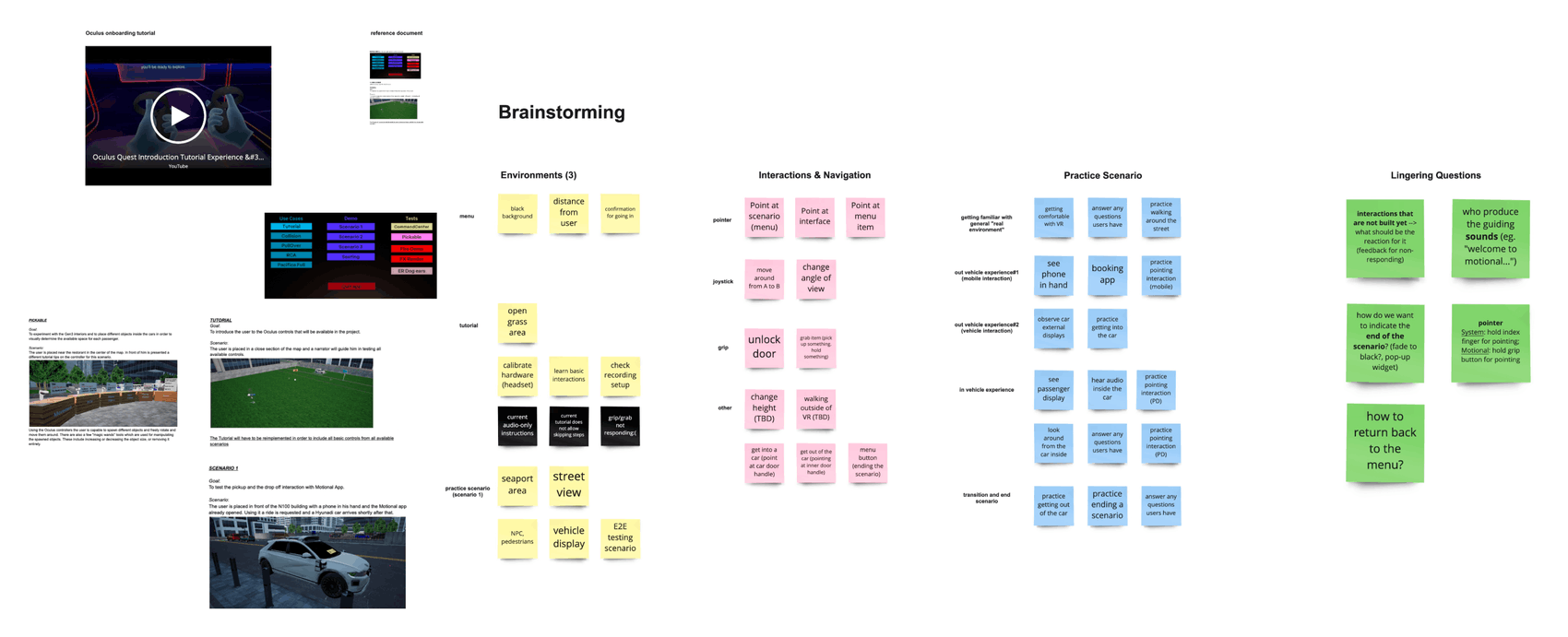
Through affinity diagramming and mapping the current user journeys for both UX researchers and participants, I identified the key pain points and design needs for:

  • Streamlining the process of setting up and running VR projects
  • Standardizing protocols for VR setup and testing across roles
  • Educating participants on basic VR knowledge before the research session
Brainstorming and user journey mapping
Click to expand
Brainstorming session — mapping interactions, navigation, practice scenarios, and logging questions across researcher and participant needs
3

Proposing different interfaces for different needs

I proposed using different interfaces to target different design needs and user groups:

  • For aligning the team's vision on VR project management and standardizing UX work, I drafted a checklist and write-up protocol — a shared document layer, not a VR interface
  • For easing the VR learning curve for future participants, I decided to illustrate design ideas for the VR interface — an in-headset tutorial experience
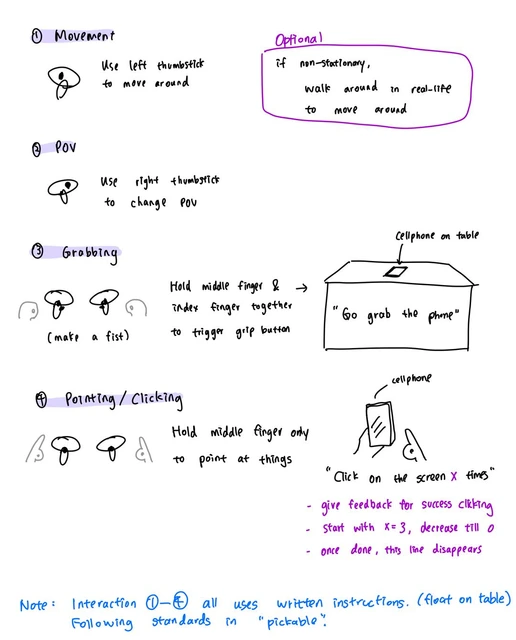
VR interaction sketches — movement, POV, grabbing, clicking
Click to expand
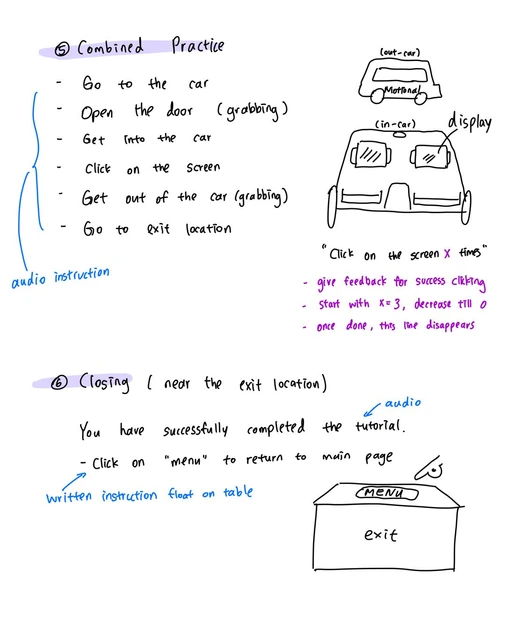
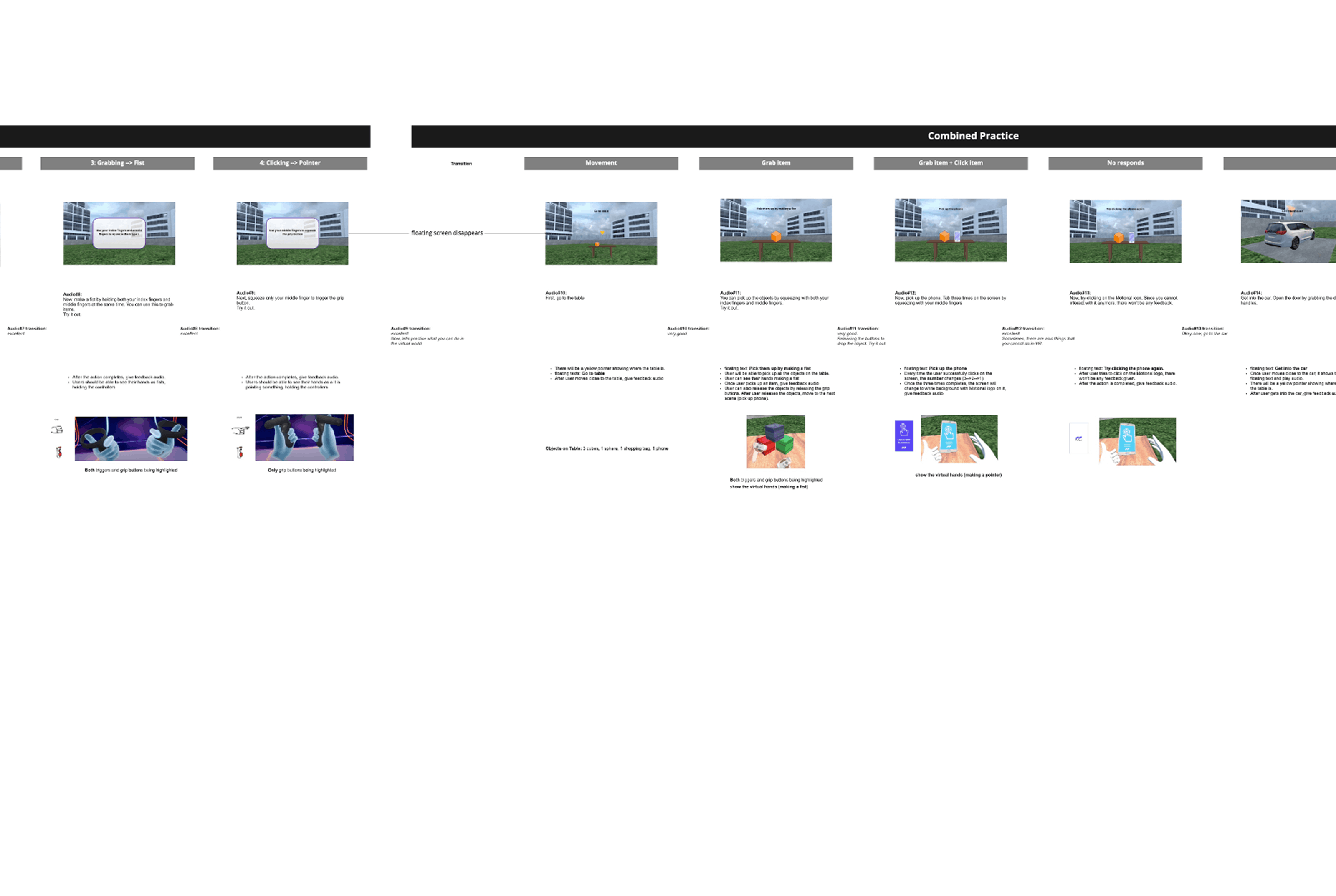
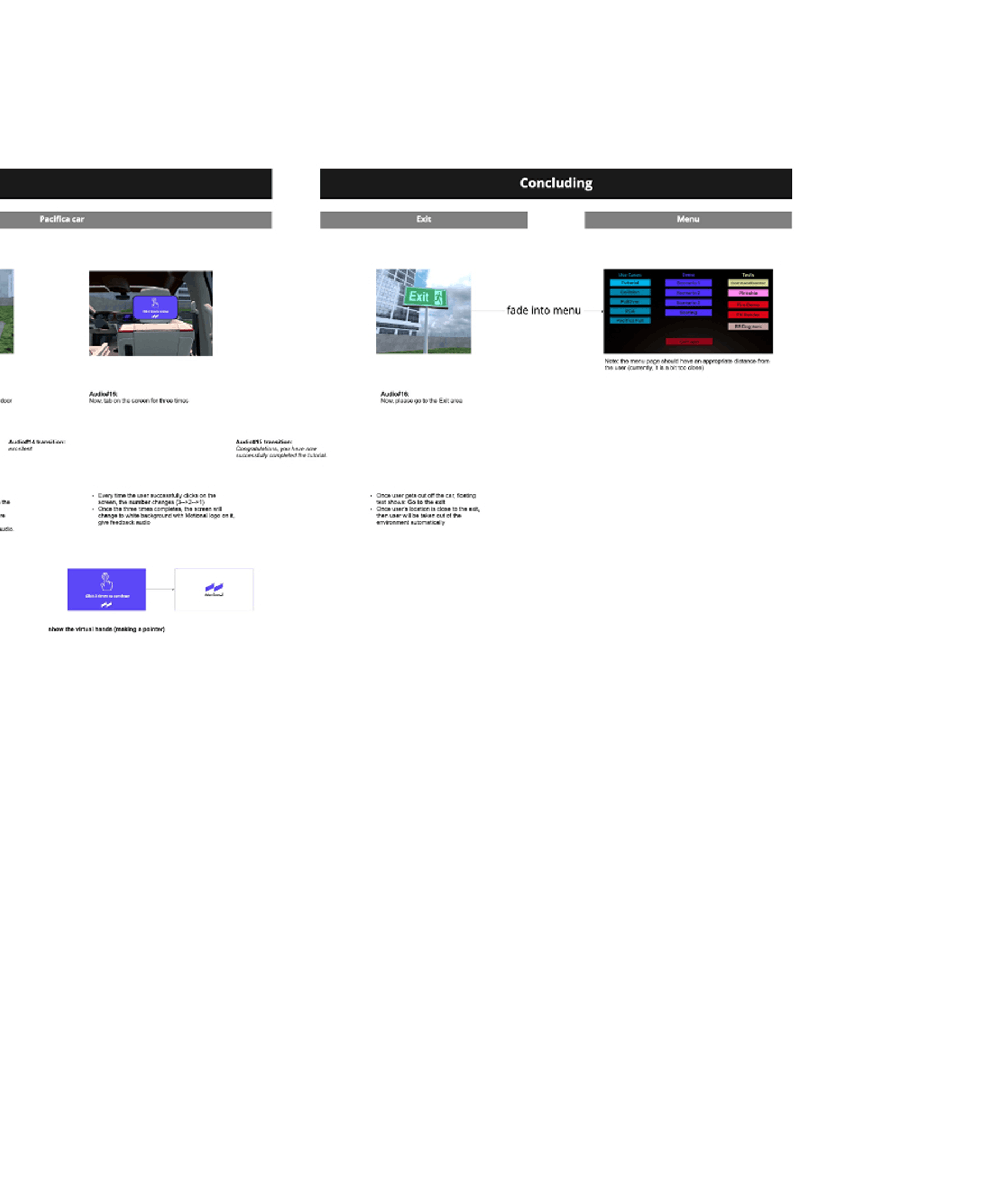
VR interaction sketches — combined practice and closing flow
Click to expand
Early sketches — VR interaction mechanics (movement, POV, grabbing, clicking) and combined practice flow for the in-headset tutorial
4

Iterating with cross-functional feedback — 12+ iterations

I iterated my designs based on feedback from UXR, designers, and 3D artists to understand usability and feasibility. For helping users better understand interactions and instructions in VR environments, I decided to design a Motional-specific VR tutorial.

I explored ways of delivering messages in both 2D and 3D interfaces inside VR — running through 12+ iterations to find the right approach for Motional's brand and the constraints of the headset environment.

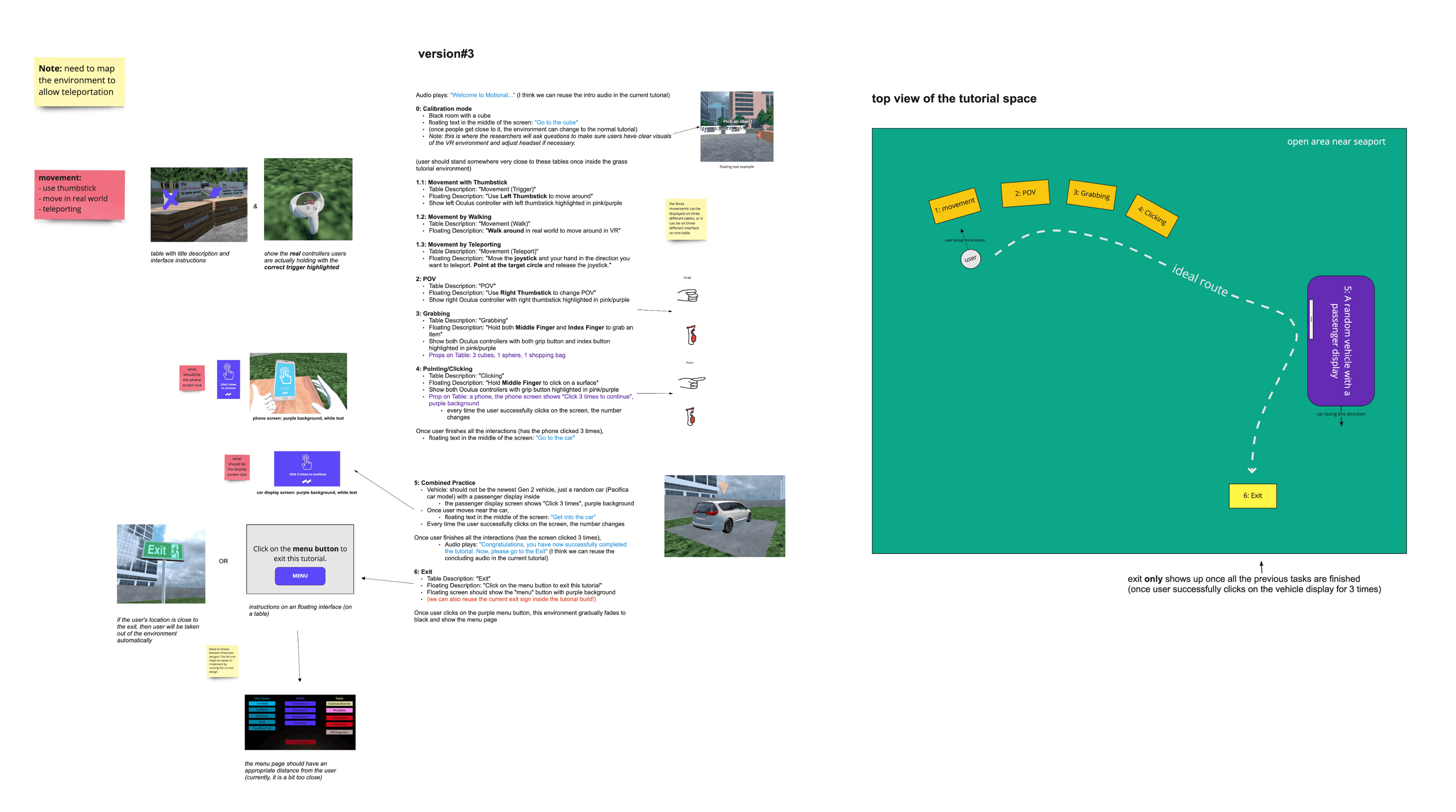
Version 3 iteration flow and top-view of tutorial space
Click to expand
V3 iteration flow and top-view spatial map of the tutorial environment — defining participant movement and interaction checkpoints
5

Testing, iterating, and validating with participants

With support from 3D artists and UXR, I created the first version of the VR tutorial and recorded 7 internal participants for testing.

After gathering the first round of feedback, I suggested changes and launched the second version in the VR environment — tested again with 12 participants with different levels of experience with VR.

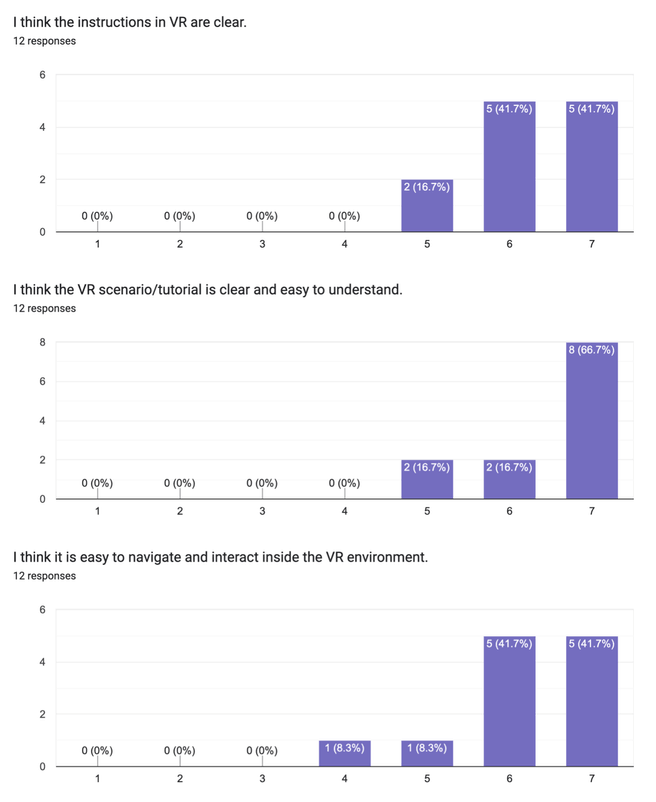
Testing results — participant survey responses across 3 dimensions
V2 testing results — 12 participants rated instructions clarity, tutorial comprehension, and ease of navigation highly (6–7 out of 7)

"The interactions are very intuitive in the tutorial and I liked how they are Motional branded and connect with the instructions in the tutorial."

— Senior AV Engineer, some experience with VR

"I enjoyed the tutorial and the feedback provided in each step along the way. They are very clear and easy to follow."

— Administrative Assistant, zero experience with VR
6

Handing off research and design documentation

I compiled and handed off all research findings, design documentation, and annotated prototypes to the XR Experience Team — including the researcher checklist protocol, VR tutorial specifications, and recommendations for future iterations.

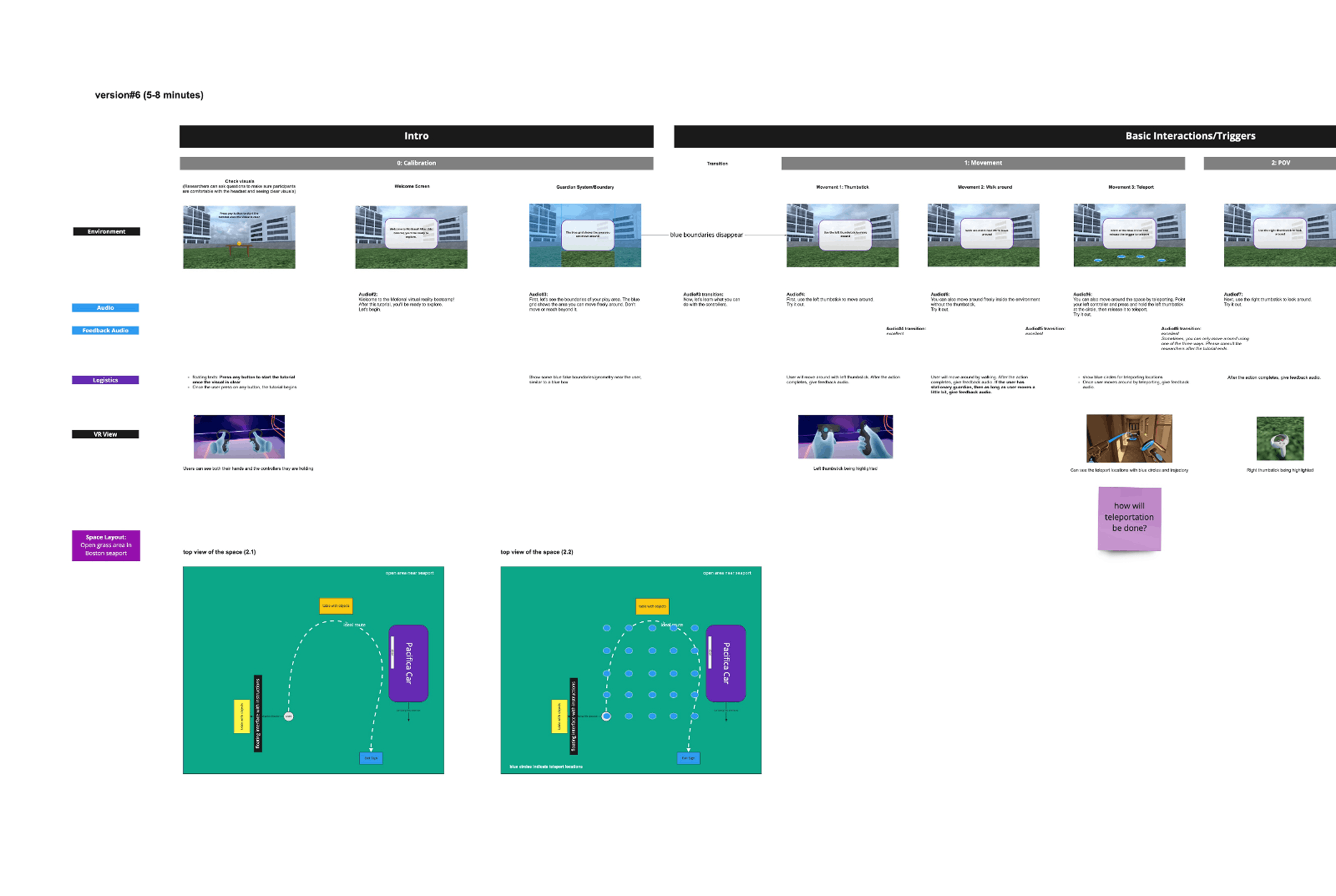
Storyboard — Intro and Basic Interactions Storyboard — Combined Practice Storyboard — Pause Car and Concluding sections
← Scroll to explore the full storyboard →
VR Checklist and Testing Protocol — AV Experience Team
VR Checklist & Testing Protocol — researcher-facing documentation standardizing how the AV Experience Team sets up and runs VR sessions
Final Experience Demo
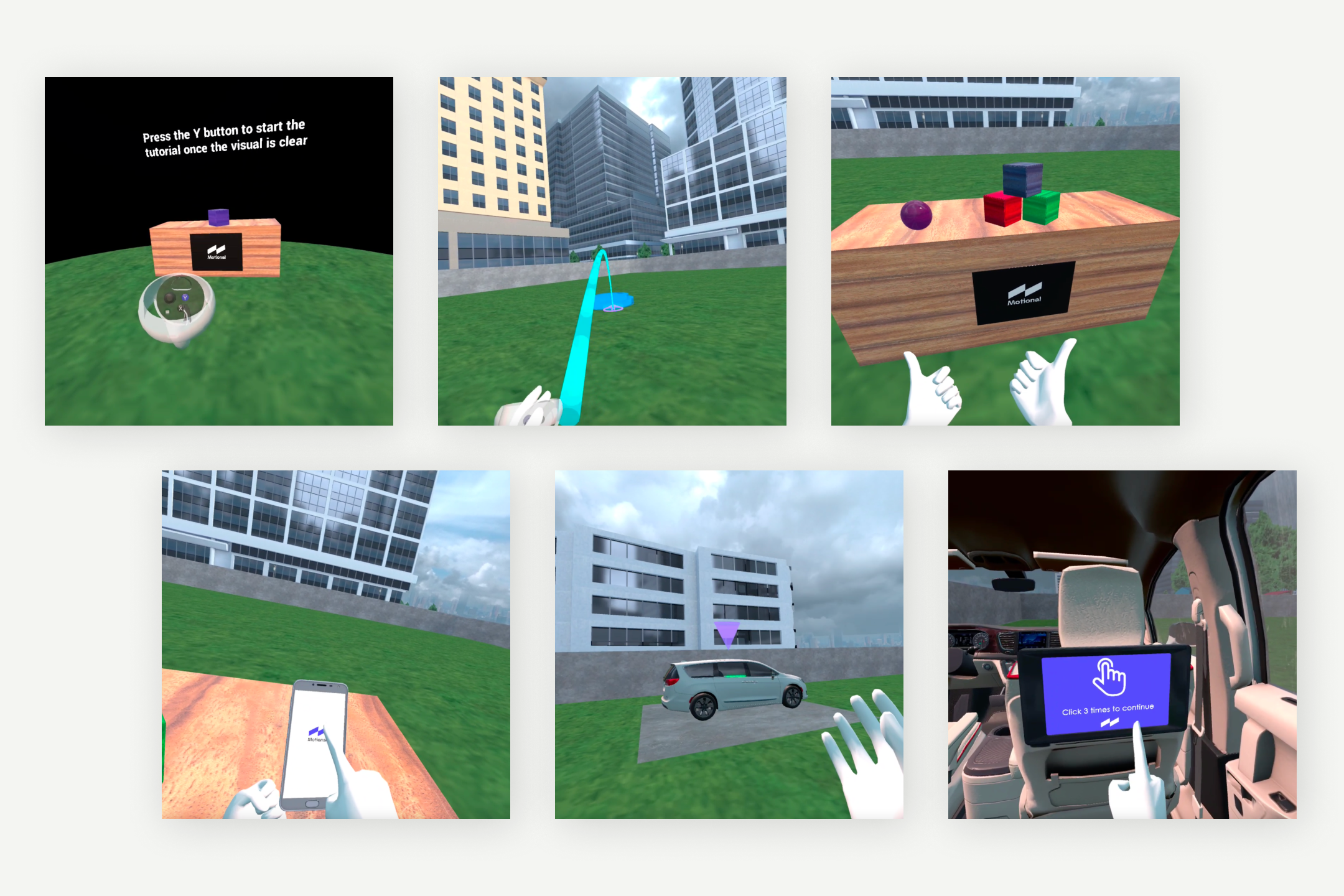
Watch the final VR tutorial in action — the full end-to-end onboarding experience for autonomous ride-hailing research participants

What I shipped in one summer

+60%
Increase in user satisfaction from V1 to V2 of the VR tutorial
19
Total participants tested across two rounds of VR research sessions
12+
Design iterations across 2D and 3D interface explorations in VR
1

Shipped end-to-end — research through prototype

Delivered a full end-to-end flow and VR prototype within a short period, collaborating with cross-functional stakeholders across all stages: from research and design to execution and testing.

2

Multi-modal product framework

Built cross-functional user research and defined a product framework with annotated and interactive prototypes using Figma, Miro, Framer, and Unreal Engine — bridging the gap between 2D and 3D design.

3

Created reusable frameworks for the team

Created cohesion and strong cross-team communication by delivering the first VR tutorial and project frameworks that can be applied to multiple teams and research initiatives beyond this single project.

What I took away

1

Propose creative solutions while dealing with ambiguous requirements

Gathering as much information as possible from all cross-team partners is important to stay informed with the current state of the art and better understand the constraints. I learned how open communication and collaboration should set the direction — and that design decisions must be based on feedback and iteration, not assumptions made alone.

2

Research informs design — even in novel mediums

Designing for VR was a new challenge: the spatial constraints, the participant cognitive load, and the lack of established conventions required me to test ideas I couldn't fully validate through static mockups. I learned to approach research and prototyping as an iterative loop — talking to people, trying things in the headset, and revising quickly.

3

Cross-functional collaboration is the design process in hardware-adjacent work

Working alongside 3D artists and UX researchers taught me that in XR, design and implementation are inseparable. What looks good in a 2D mockup might not work spatially in the headset. Close collaboration with 3D artists wasn't a nice-to-have — it was the only way to ship something real.